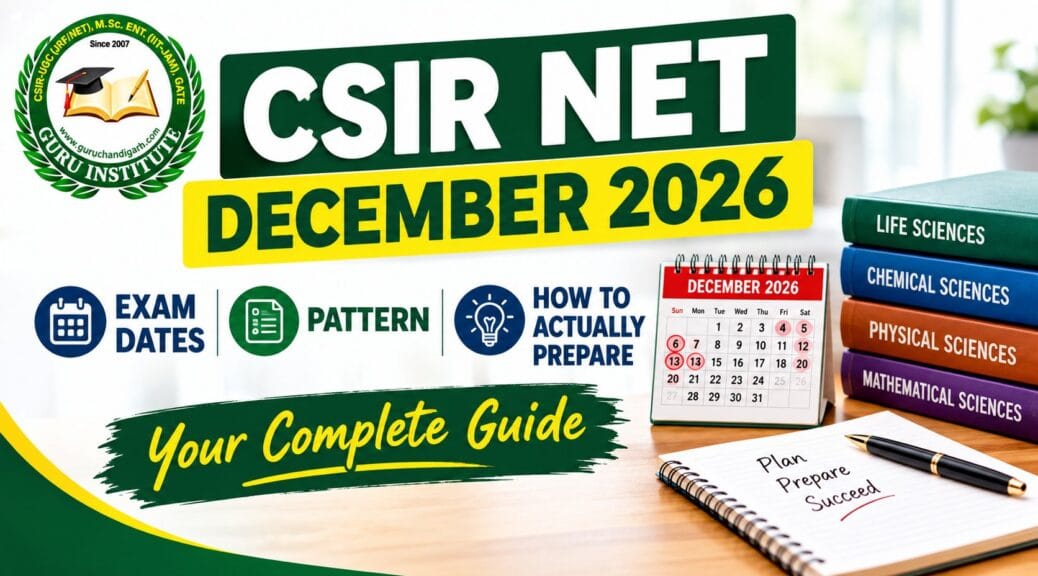
CSIR NET December 2026: Exam Dates, Pattern and How to Actually Prepare
If you’ve been scrolling through CSIR NET forums lately, you already know the December cycle is coming up fast, and half the confusion online is people mixing up old marking schemes with new ones, or quoting dates that were never official in the first place. So let’s clear that up first, then get into the paper structure subject by subject — because honestly, that’s where most students lose marks, not in the syllabus itself but in not knowing how their specific paper is weighted. And if you’re based in Chandigarh and thinking about joining structured CSIR NET coaching in Chandigarh for this attempt, knowing the exact pattern below will help you judge whether any coaching institute you’re considering is actually teaching to the real exam or just running generic classes.
So, When Exactly Is the Exam?
NTA put out its exam calendar for December 2026 through March 2027, and in it, the Joint CSIR-UGC NET December cycle has been marked for 20 and 21 December 2026. Worth remembering this is still a proposed date — NTA tends to lock things in properly (city slip, admit card, the works) only closer to the exam, through its own bulletin on csirnet.nta.nic.in.
Looking back at how the December 2025 cycle went — notification and forms opened around late September, applications shut about a month after, a short correction window followed, exam landed mid-December — it’s a fair bet this year follows roughly the same rhythm. Notification sometime in September, exam in the third week of December.
Don’t wait around for the official notice to start though. Most toppers I’ve come across started their revision the moment the previous cycle’s result came out, not when the form opened.
What the Paper Actually Looks Like
Total marks: 200. Duration: 3 hours flat, no extra time regardless of subject. And it’s split into three parts — A, B, C — same structure across all five subjects, though the weight of each part changes depending on what you’ve picked.
CSIR NET Exam Pattern 2026 — Overview
| Particulars | Details |
| Name of Exam | Council of Scientific and Industrial Research – National Eligibility Test |
| Number of Papers | 5 — Chemical Science, Earth Sciences, Life Sciences, Mathematical Sciences, Physical Sciences |
| Paper Codes | Chemical Science 701, Earth/Atmospheric/Ocean/Planetary Sciences 702, Life Science 703, Mathematical Science 704, Physical Science 705 |
| Total Questions / Attempted | Chemical Science 120/75, Earth Sciences 150/75, Life Science 145/75, Mathematical Science 120/60, Physical Science 75/55 |
| Exam Mode | Online, Computer-Based Test |
| Duration | 180 minutes |
| Question Type | MCQs |
| Total Marks | 200 |
| Marking Scheme | Varies by subject |
| Language | English and Hindi |
Part A is the one thing every candidate shares — General Aptitude, meaning logical reasoning, graph reading, series, puzzles, that sort of thing. Doesn’t matter if you’re a chemistry student or a mathematician, you’re solving the same Part A questions as everyone else. Part B and Part C, though, are entirely subject-driven, and B tends to be conventional MCQs while C leans into trickier, applied questions.
You pick your subject when filling the form, and no, you can’t switch it afterward, so choose carefully:
- Chemical Science
- Earth Science
- Life Science
- Mathematical Science
- Physical Science
Now, Subject by Subject
This is honestly the part most guides gloss over, and it’s the part that matters most for your strategy. Same exam name, but five very different papers underneath.
Chemical Science
| Section | Part A | Part B | Part C | Total |
| Total Questions | 20 | 40 | 60 | 120 |
| Max to Attempt | 15 | 35 | 25 | 75 |
| Max Marks | 30 | 70 | 100 | 200 |
| Marks per Correct | 2 | 2 | 4 | – |
| Negative per Wrong | 0.5 | 0.5 | 1 | – |
120 questions on the paper, 75 to attempt, same 3-hour clock as everyone else. A and B pay 2 marks each; C doubles that to 4. Wrong answers cost 0.5 in the first two sections and a full mark once you’re in C.
Earth Science
| Section | Part A | Part B | Part C | Total |
| Total Questions | 20 | 50 | 80 | 150 |
| Max to Attempt | 15 | 35 | 25 | 75 |
| Max Marks | 30 | 70 | 100 | 200 |
| Marks per Correct | 2 | 2 | 4 | – |
| Negative per Wrong | 0.5 | 0.5 | 1.32 | – |
Biggest paper of the lot — 150 questions in total, pulling from Geology, Applied Geology, Physical Geography, Geophysics, Meteorology and Ocean Sciences. Marking mirrors Chemical Science through A and B, but Part C here docks you 1.32 marks per wrong answer, the harshest penalty of any subject on this list.
Mathematical Science
| Section | Part A | Part B | Part C | Total |
| Total Questions | 20 | 40 | 60 | 120 |
| Max to Attempt | 15 | 25 | 20 | 60 |
| Max Marks | 30 | 75 | 95 | – |
| Marks per Correct | 2 | 3 | 4.75 | – |
| Negative per Wrong | 0.5 | 0.75 | 0 | – |
Only 60 of the 120 questions get attempted here, so choosing which ones to answer matters more in Math than anywhere else. Part A has single correct options; B and C can have more than one right answer per question. And here’s the one genuinely useful quirk in the whole exam — Part C carries zero negative marking. Nowhere else in CSIR NET can you attempt a question wrong and lose nothing.
Life Science
| Section | Part A | Part B | Part C | Total |
| Total Questions | 20 | 50 | 75 | 145 |
| Max to Attempt | 15 | 35 | 25 | 75 |
| Max Marks | 30 | 70 | 100 | 200 |
| Marks per Correct | 2 | 2 | 4 | – |
| Negative per Wrong | 0.5 | 0.5 | 1 | – |
145 total questions, 75 to attempt, standard 3-hour window. Marking follows the same pattern as Chemical Science — 2 marks in A and B, 4 in C, negative marking of 0.5 and then 1.
Physical Science
| Section | Part A | Part B | Part C | Total |
| Total Questions | 20 | 25 | 30 | 75 |
| Max to Attempt | 15 | 20 | 20 | 55 |
| Max Marks | 30 | 70 | 100 | 200 |
| Marks per Correct | 2 | 3.5 | 5 | – |
| Negative per Wrong | 0.5 | 0.75 | 1.25 | – |
Shortest paper on offer — just 75 questions, 55 attempted. Syllabus splits into Core and Advanced, with Advanced pulling in Condensed Matter Physics, Nuclear and Particle Physics, Atomic and Molecular Physics. Marks climb steeply here too: 2, then 3.5, then 5 per question, with negative marking rising right alongside it.
Negative Marking, All Five Subjects Side by Side
| Subject | Total Marks | Negative Marking (A/B/C) | Marks per Correct (A/B/C) |
| Chemical Science | 200 | −0.5 / −0.5 / −1 | +2 / +2 / +4 |
| Earth Science | 200 | −0.5 / −0.5 / −1.32 | +2 / +2 / +4 |
| Life Science | 200 | −0.5 / −0.5 / −1 | +2 / +2 / +4 |
| Mathematical Science | 200 | −0.5 / −0.75 / 0 | +2 / +3 / +4.75 |
| Physical Science | 200 | −0.5 / −0.75 / −1.25 | +2 / +3.5 / +5 |
If you’re weighing whether to guess on a Part C question, this table basically tells you the answer. In Math, go ahead — nothing to lose. In Earth Science, think twice, because a wrong guess there costs more than in any other subject.
Qualifying Marks
General category candidates need 33% combined across Part A and Part B, plus 50% in Part C. OBC-NCL, SC, ST and PwD candidates get a lower bar — 25% in A and B, 40% in C. Same cutoff logic whether you’re sitting the June or December session.
What Actually Helps
Honestly, most of this comes down to a handful of things, not some elaborate strategy.
Figure out which topics carry the most weight before you open a single book. Past papers tell you this faster than any syllabus PDF will.
Don’t skip Part A just because it “feels easy.” Plenty of strong chemistry or physics students lose marks here purely because they never practiced it seriously.
Attempt mock tests with negative marking switched on, every single time. Guessing habits you build without penalty don’t transfer to the real exam, and the penalty structure genuinely changes by subject — what’s safe in Math might be costly in Earth Science.
Go through the last five or six years of papers for your subject specifically. CSIR NET repeats patterns even when it changes the exact questions, so this is where the real prep happens.
Don’t write off Part C as “too advanced to bother with.” It pays the most per question in every subject, and a decent hold on it can cover for a weaker attempt elsewhere.
Work backward from December 20–21. If notification lands in September like it usually does, that’s roughly three months — enough for one full pass, one revision round, and two weeks of mocks at the end, assuming you don’t leave it all for the last month.
If self-study alone feels shaky, especially for Part C, this is exactly where good CSIR NET coaching in Chandigarh makes a real difference — a structured classroom setting, doubt-clearing sessions, and regular subject-wise mock tests can cut down the guesswork considerably compared to preparing entirely on your own.
That’s really it. No shortcuts, just knowing your specific paper well enough that nothing on exam day surprises you.
Frequently Asked Questions
Q1. When is the CSIR NET December 2026 exam happening?
NTA’s calendar has it down for 20 and 21 December 2026, but that’s still a proposed date at this point. They’ll firm it up — along with the notification, admit card, and exam city slip — closer to the actual exam.
Q2. Which subject has the harshest negative marking?
Earth Science, hands down. Part C there costs you 1.32 marks per wrong answer, worse than anywhere else in the exam. Math sits at the other extreme — no negative marking at all in Part C, so it’s the one section across all five subjects where a wrong guess doesn’t hurt you.
Q3. What marks do I need to actually qualify?
For the General category, it’s 33% combined across Parts A and B, plus 50% in Part C. That drops to 25% and 40% respectively for OBC-NCL, SC, ST and PwD candidates. Doesn’t matter if you’re attempting in June or December — same cutoffs either way.