
Category Archives: csir net

CSIR NET Selection Process 2027: Step-by-Step Guide

I’ve seen this happen a lot. Two students study the same hours, from the same books. One clears the exam, the other doesn’t. When you ask what went wrong, it’s rarely the preparation. One of them understood how the whole thing works from day one. The other figured it out halfway through.

CSIR NET isn’t just an exam. It’s a chain: form, admit card, paper, answer key, result, certificate. If one link breaks, you might be waiting six months for the next attempt.

A warning before I go on. The 2027 dates aren’t announced yet. Everything below is based on how the last few cycles went, so check csirnet.nta.ac.in before you plan around any date.

Can you apply at all?

You need a Master’s or an equivalent degree (B.Sc. Hons, BS-MS, B.Tech, B.Pharma) in a science subject. General category needs 55%. SC, ST, OBC-NCL and PwD candidates get 5% relaxation.

However, if your results for your final year are still outstanding, you can always apply. However, it is advisable to read the notice keenly since it mentions the deadline within which you should have graduated.

Age matters only for JRF. The limit has been around 30, with relaxation for reserved categories. If you only want Assistant Professor eligibility, there’s no age limit.

Choosing your subject

There are five: Chemical Sciences, Earth Sciences, Life Sciences, Mathematical Sciences and Physical Sciences. Pick the one you actually studied in your M.Sc. “My senior said that subject scores easier” is a bad reason, and once the form is submitted you can’t change it.

The form

Examination is conducted two times in a year, i.e., June and December, and the form becomes available a few months prior to both the examinations. You have to register yourself for the examination by filling in the details and paying the fee.

It’s easy and hence people fail to do it. The photograph is of incorrect size. The name on it doesn’t tally with that on the marksheet. The scanning is done so poorly that no one can comprehend anything from it. Keep all documents at hand prior to filling the application form. If there is a window for corrections, use it.

City slip and admit card

The exam city slip comes first, and the admit card follows a little later. Read all of it: name, subject, centre, reporting time. Carry a printout and a photo ID. Don’t count on showing it on your phone.

What the paper looks like

It’s a computer-based test, three hours, 200 marks, in three parts.

Part A comprises general aptitude and is written by all candidates: reasoning, data interpretation, elementary mathematics. Part B tests the candidate’s knowledge of the subject at the normal level. Part C is considered the difficult part, since the emphasis is on application of concepts.f

How many questions you attempt, and how negative marking works, depends on your subject. Read your own bulletin. Please don’t take advice from someone in a different stream about how the paper “feels.”

On the day, reach early. Start with the part you’re most comfortable with so your nerves settle. If wrong answers cost you marks, don’t guess blindly. And watch the clock in Part C, since it eats time without you noticing.

The answer key

A few days after the exam, NTA releases a provisional key along with your recorded responses. If you think an answer is wrong, you can challenge it. There’s a fee per question and you have to attach proof. Experts review the challenges and then the final key comes out, and your result is based on that one.

So check your responses even if the paper felt terrible. Sometimes it went better than you thought.

Result and cut-off

There’s no fixed pass mark. NTA decides the cut-off for each subject and category after seeing how that session went. You land in one of three groups:

  • JRF plus Assistant Professor eligibility (top scorers within the age limit)
  • Assistant Professor eligibility only
  • Eligibility for PhD admission

After you qualify

Download your e-certificate from the NTA portal. If you got JRF, you’ll need a host institute or a guide, and you have to register for a PhD within the validity period, which has usually been two years. Fellowship amounts get revised from time to time, so go by the latest CSIR notice and not an old blog post (including this one).

Preparing in the meantime

Before you buy yet another thick book, solve old papers, five to eight years of them. Nothing shows you what the exam really asks like they do.

Divide the syllabus into different units and revise them once a week. We all continue to study things that we like and ignore those that we find tough.

Give yourself mocks during the exact time of the actual examination. Don’t wait till the last month to revise Part A; it seems easier than others, so people ignore it, which is the reason for losing marks.

There are some concepts which are difficult to understand alone such as quantum mechanics, organic mechanisms, real analysis. If someone has been trying to understand something for three days, then a good mentor will solve it in ten minutes and give one week more time. That is why many students start considering classroom coaching in Chandigarh after studying for a few months alone.

And if you choose this option, then inquire about the experience level of the faculty, the number of people in each batch, and the frequency of the tests. Consult a person who has gone to this school before. Check the mentoring and test preparation procedures before spending money on it.

Bottom line

Check your eligibility early. Fill the form slowly. Learn the pattern for your own subject. Practise with a timer. None of it is clever, but it works.

FAQs

How many times in a year does CSIR NET take place?

Twice, typically in June and December. The schedule is released by NTA through its official website.

 Is it possible to apply when my final year M.Sc. is going on?

Typically yes. While the result is yet to be out, you need to complete your degree within the deadline mentioned in the notification.

 Is there any negative marking in CSIR NET exam?

Yes, generally in all subjects, but the policy differs by subject and parts. The bulletin of your subject will let you know about that.

 What is the difference between JRF eligibility and Assistant Professor Eligibility?

While in JRF eligibility you get fellowship along with teaching eligibility, in Assistant Professor eligibility you only get teaching eligibility.
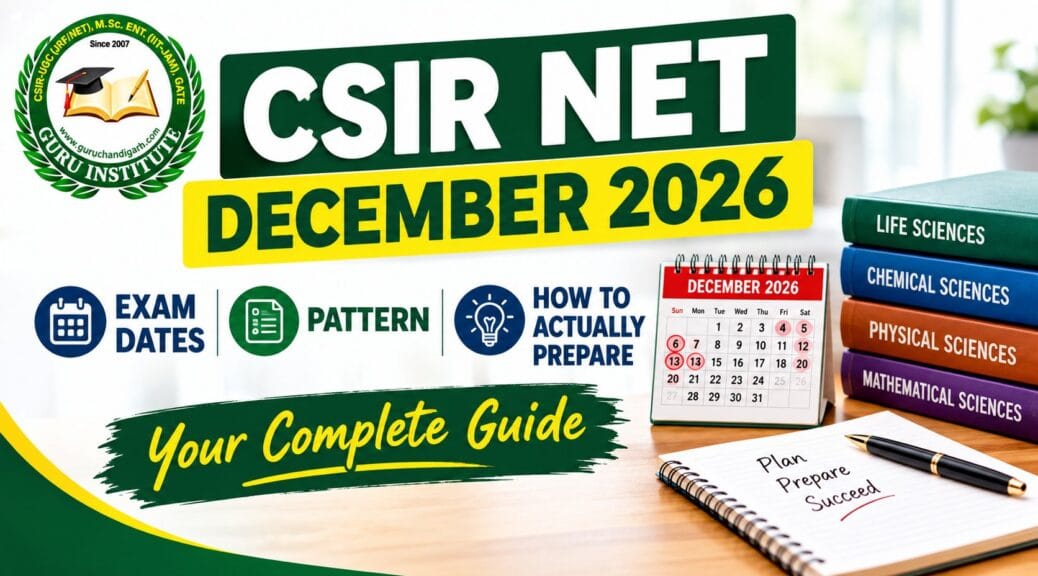
CSIR NET December 2026: Exam Dates, Pattern and How to Actually Prepare

If you’ve been scrolling through CSIR NET forums lately, you already know the December cycle is coming up fast, and half the confusion online is people mixing up old marking schemes with new ones, or quoting dates that were never official in the first place. So let’s clear that up first, then get into the paper structure subject by subject — because honestly, that’s where most students lose marks, not in the syllabus itself but in not knowing how their specific paper is weighted. And if you’re based in Chandigarh and thinking about joining structured CSIR NET coaching in Chandigarh for this attempt, knowing the exact pattern below will help you judge whether any coaching institute you’re considering is actually teaching to the real exam or just running generic classes.

So, When Exactly Is the Exam?

NTA put out its exam calendar for December 2026 through March 2027, and in it, the Joint CSIR-UGC NET December cycle has been marked for 20 and 21 December 2026. Worth remembering this is still a proposed date — NTA tends to lock things in properly (city slip, admit card, the works) only closer to the exam, through its own bulletin on csirnet.nta.nic.in.

Looking back at how the December 2025 cycle went — notification and forms opened around late September, applications shut about a month after, a short correction window followed, exam landed mid-December — it’s a fair bet this year follows roughly the same rhythm. Notification sometime in September, exam in the third week of December.

Don’t wait around for the official notice to start though. Most toppers I’ve come across started their revision the moment the previous cycle’s result came out, not when the form opened.

What the Paper Actually Looks Like

Total marks: 200. Duration: 3 hours flat, no extra time regardless of subject. And it’s split into three parts — A, B, C — same structure across all five subjects, though the weight of each part changes depending on what you’ve picked.

CSIR NET Exam Pattern 2026 — Overview

Particulars Details
Name of Exam Council of Scientific and Industrial Research – National Eligibility Test
Number of Papers 5 — Chemical Science, Earth Sciences, Life Sciences, Mathematical Sciences, Physical Sciences
Paper Codes Chemical Science 701, Earth/Atmospheric/Ocean/Planetary Sciences 702, Life Science 703, Mathematical Science 704, Physical Science 705
Total Questions / Attempted Chemical Science 120/75, Earth Sciences 150/75, Life Science 145/75, Mathematical Science 120/60, Physical Science 75/55
Exam Mode Online, Computer-Based Test
Duration 180 minutes
Question Type MCQs
Total Marks 200
Marking Scheme Varies by subject
Language English and Hindi

Part A is the one thing every candidate shares — General Aptitude, meaning logical reasoning, graph reading, series, puzzles, that sort of thing. Doesn’t matter if you’re a chemistry student or a mathematician, you’re solving the same Part A questions as everyone else. Part B and Part C, though, are entirely subject-driven, and B tends to be conventional MCQs while C leans into trickier, applied questions.

You pick your subject when filling the form, and no, you can’t switch it afterward, so choose carefully:

  • Chemical Science
  • Earth Science
  • Life Science
  • Mathematical Science
  • Physical Science

Now, Subject by Subject

This is honestly the part most guides gloss over, and it’s the part that matters most for your strategy. Same exam name, but five very different papers underneath.

Chemical Science

Section Part A Part B Part C Total
Total Questions 20 40 60 120
Max to Attempt 15 35 25 75
Max Marks 30 70 100 200
Marks per Correct 2 2 4 –
Negative per Wrong 0.5 0.5 1 –

120 questions on the paper, 75 to attempt, same 3-hour clock as everyone else. A and B pay 2 marks each; C doubles that to 4. Wrong answers cost 0.5 in the first two sections and a full mark once you’re in C.

Earth Science

Section Part A Part B Part C Total
Total Questions 20 50 80 150
Max to Attempt 15 35 25 75
Max Marks 30 70 100 200
Marks per Correct 2 2 4 –
Negative per Wrong 0.5 0.5 1.32 –

Biggest paper of the lot — 150 questions in total, pulling from Geology, Applied Geology, Physical Geography, Geophysics, Meteorology and Ocean Sciences. Marking mirrors Chemical Science through A and B, but Part C here docks you 1.32 marks per wrong answer, the harshest penalty of any subject on this list.

Mathematical Science

Section Part A Part B Part C Total
Total Questions 20 40 60 120
Max to Attempt 15 25 20 60
Max Marks 30 75 95 –
Marks per Correct 2 3 4.75 –
Negative per Wrong 0.5 0.75 0 –

Only 60 of the 120 questions get attempted here, so choosing which ones to answer matters more in Math than anywhere else. Part A has single correct options; B and C can have more than one right answer per question. And here’s the one genuinely useful quirk in the whole exam — Part C carries zero negative marking. Nowhere else in CSIR NET can you attempt a question wrong and lose nothing.

Life Science

Section Part A Part B Part C Total
Total Questions 20 50 75 145
Max to Attempt 15 35 25 75
Max Marks 30 70 100 200
Marks per Correct 2 2 4 –
Negative per Wrong 0.5 0.5 1 –

145 total questions, 75 to attempt, standard 3-hour window. Marking follows the same pattern as Chemical Science — 2 marks in A and B, 4 in C, negative marking of 0.5 and then 1.

Physical Science

Section Part A Part B Part C Total
Total Questions 20 25 30 75
Max to Attempt 15 20 20 55
Max Marks 30 70 100 200
Marks per Correct 2 3.5 5 –
Negative per Wrong 0.5 0.75 1.25 –

Shortest paper on offer — just 75 questions, 55 attempted. Syllabus splits into Core and Advanced, with Advanced pulling in Condensed Matter Physics, Nuclear and Particle Physics, Atomic and Molecular Physics. Marks climb steeply here too: 2, then 3.5, then 5 per question, with negative marking rising right alongside it.

Negative Marking, All Five Subjects Side by Side

Subject Total Marks Negative Marking (A/B/C) Marks per Correct (A/B/C)
Chemical Science 200 −0.5 / −0.5 / −1 +2 / +2 / +4
Earth Science 200 −0.5 / −0.5 / −1.32 +2 / +2 / +4
Life Science 200 −0.5 / −0.5 / −1 +2 / +2 / +4
Mathematical Science 200 −0.5 / −0.75 / 0 +2 / +3 / +4.75
Physical Science 200 −0.5 / −0.75 / −1.25 +2 / +3.5 / +5

If you’re weighing whether to guess on a Part C question, this table basically tells you the answer. In Math, go ahead — nothing to lose. In Earth Science, think twice, because a wrong guess there costs more than in any other subject.

Qualifying Marks

General category candidates need 33% combined across Part A and Part B, plus 50% in Part C. OBC-NCL, SC, ST and PwD candidates get a lower bar — 25% in A and B, 40% in C. Same cutoff logic whether you’re sitting the June or December session.

What Actually Helps

Honestly, most of this comes down to a handful of things, not some elaborate strategy.

Figure out which topics carry the most weight before you open a single book. Past papers tell you this faster than any syllabus PDF will.

Don’t skip Part A just because it “feels easy.” Plenty of strong chemistry or physics students lose marks here purely because they never practiced it seriously.

Attempt mock tests with negative marking switched on, every single time. Guessing habits you build without penalty don’t transfer to the real exam, and the penalty structure genuinely changes by subject — what’s safe in Math might be costly in Earth Science.

Go through the last five or six years of papers for your subject specifically. CSIR NET repeats patterns even when it changes the exact questions, so this is where the real prep happens.

Don’t write off Part C as “too advanced to bother with.” It pays the most per question in every subject, and a decent hold on it can cover for a weaker attempt elsewhere.

Work backward from December 20–21. If notification lands in September like it usually does, that’s roughly three months — enough for one full pass, one revision round, and two weeks of mocks at the end, assuming you don’t leave it all for the last month.

If self-study alone feels shaky, especially for Part C, this is exactly where good CSIR NET coaching in Chandigarh makes a real difference — a structured classroom setting, doubt-clearing sessions, and regular subject-wise mock tests can cut down the guesswork considerably compared to preparing entirely on your own.

That’s really it. No shortcuts, just knowing your specific paper well enough that nothing on exam day surprises you.

Frequently Asked Questions

Q1. When is the CSIR NET December 2026 exam happening?
NTA’s calendar has it down for 20 and 21 December 2026, but that’s still a proposed date at this point. They’ll firm it up — along with the notification, admit card, and exam city slip — closer to the actual exam.

Q2. Which subject has the harshest negative marking?
Earth Science, hands down. Part C there costs you 1.32 marks per wrong answer, worse than anywhere else in the exam. Math sits at the other extreme — no negative marking at all in Part C, so it’s the one section across all five subjects where a wrong guess doesn’t hurt you.

Q3. What marks do I need to actually qualify?
For the General category, it’s 33% combined across Parts A and B, plus 50% in Part C. That drops to 25% and 40% respectively for OBC-NCL, SC, ST and PwD candidates. Doesn’t matter if you’re attempting in June or December — same cutoffs either way.